

Controls Are Vital
- Bill Shapcott

- 1 day ago
- 3 min read
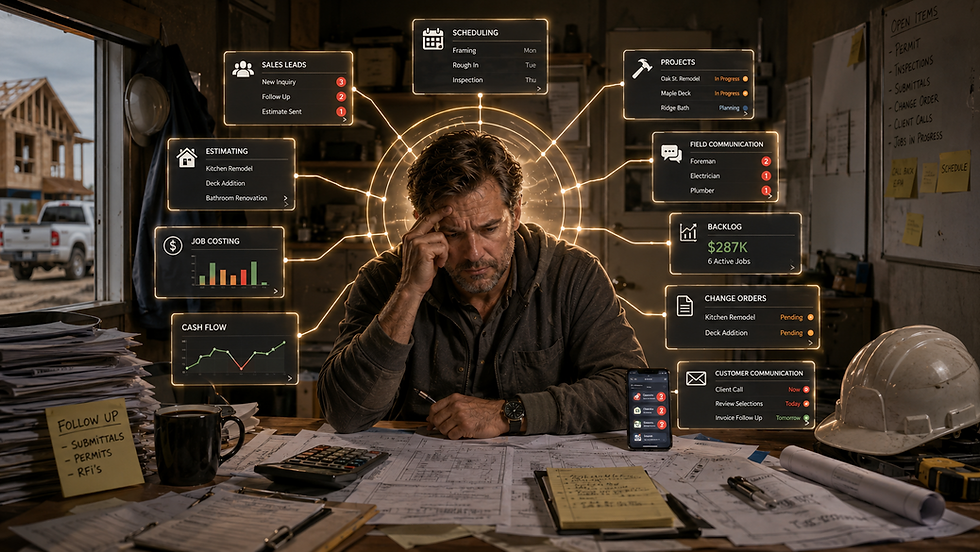
When your construction business was small, staying in control was relatively simple.
You could walk every job, answer every customer call, approve every purchase, check the bank account, and know exactly what was happening. If something went wrong, you usually found out quickly because you were involved in almost every decision.
Growth changes that.
Today, you may have 30 or 40 employees, dozens of subcontractors and suppliers, hundreds of customers, multiple projects underway, and millions of dollars flowing through the business each year. The same hands-on approach that helped build the company is no longer enough to manage it.
The question is no longer whether your people are working hard.
The question is whether you have the right controls in place to know if the business is performing the way it should.
What Are Business Controls?
Business controls are the systems, processes, reports, and routines that give owners visibility into what is happening before problems become expensive.
Controls allow you to answer questions like:
Are projects staying on budget?
Are gross margins slipping?
Is cash flow tightening?
Are change orders being captured?
Are estimates converting into profitable work?
Are project managers following consistent processes?
Is accountability clear throughout the organization?
Without controls, owners are forced to rely on intuition, conversations, and hope.
With controls, they make decisions based on facts.
Growth Exposes Weak Controls
Many contractors believe growth itself creates problems.
It doesn't. Growth simply exposes weaknesses that already existed.
A few missed purchase orders become thousands of dollars in cost overruns.
One forgotten change order turns into lost profit.
Poor communication between estimating and operations creates expensive rework.
Delayed job costing means problems aren't discovered until the project is nearly complete. As revenue increases, small issues become large financial consequences.
Visibility Creates Confidence
One of the biggest frustrations owners experience is uncertainty.
They ask themselves:
"I know we're busy... but are we making money?"
That uncertainty creates stress because the owner becomes the company's monitoring system. Instead of leading strategically, they're constantly chasing information.
Strong controls replace uncertainty with visibility.
The right dashboards, project reporting, financial metrics, meeting rhythms, and accountability systems provide early warning signs before issues become crises.
Controls Protect Profit
Profit is rarely lost because of one major event.
It's usually lost through dozens of small decisions that go unnoticed:
Unapproved purchases
Poor labor productivity
Schedule delays
Missed billing opportunities
Scope creep
Weak project handoffs
Inaccurate estimating
Delayed collections
Good controls identify these issues while there is still time to correct them.
They help protect margins instead of explaining them after the job is complete.
The Owner Shouldn't Be the Control System
One of the clearest signs a company has outgrown its systems is when every important decision still runs through the owner.
If employees constantly need approval...
If every problem lands on your desk...
If you cannot leave for a week without worrying what you'll come back to...
Then the business is depending on you instead of operating through a reliable management system.
That's not sustainable.
Your goal should be to build a company where the systems provide control—not your constant presence.
The Bottom Line
Successful contractors don't create control by watching everyone more closely.
They create control by building better systems. The companies that continue to grow profitably are those that establish clear responsibilities, consistent processes, meaningful performance metrics, and reliable reporting that allows leadership to make informed decisions.
As your business grows, complexity increases. The only way to stay ahead of that complexity is with stronger controls.
Because in construction, what gets measured gets managed—and what gets managed gets improved.


Comments